
Dermot Keely’s epic impact and iconic status recognised in Dundalk and across the land

There are figures who lift trophies, and then there are forces of nature who leave their fingerprints on the very essence of the game long beyond their own era.
A towering, uncompromising defender who became a cunning, high-intensity tactician in the dugout, and always an unflinching advocate for football on these shores, Dermot Keely’s name is absolutely synonymous with the League of Ireland.
On Friday, October 2nd, as the hosts faced Bohs in the Premier Division at Oriel Park, Dermot became the latest inductee into the Dundalk FC / IPFBA Hall of Fame. Part of the club’s Centenary Legends series, it is a modest but still meaningful honour for someone whose CV speaks for itself and whose genuine pride in simply being part of each club history he’s enhanced is tangible.

Now 72, Dermot’s legendary reputation was earned through a no-frills playing style and unfiltered managerial persona — but those traits were only elements of a man whose appetite for the honest graft and community spirit of Irish football was always insatiable.
Dermot was and is, as his former Rovers team-mate Pat Byrne of this parish describes him, “a top-class player and person.” Or in the words of well-known Dundalk supporter Brendan Ogle:
“Dermot was an exceptional player and also an exceptional human being.”
TOUGH AS OLD BOOTS
To understand Keely’s place in Dundalk’s history, one must go back to September 1978. Born into a Dublin footballing household — his father Peter played for Shelbourne (and very nearly Leeds United), and his brother Joe won a remarkable FAI Cup medal beside him at all-amateur Home Farm in 1975 — Dermot was already an established hard-nosed defender by the time he arrived at Townparks. Having skippered St. Patrick’s Athletic and briefly played alongside Terry Venables under Barry Bridges at Inchicore, the then 23-year-old came within a whisker of moving to Australia in the summer of 1977.
Listen to Dermot’s fascinating This Football Life story (Green Shoots, 2025)

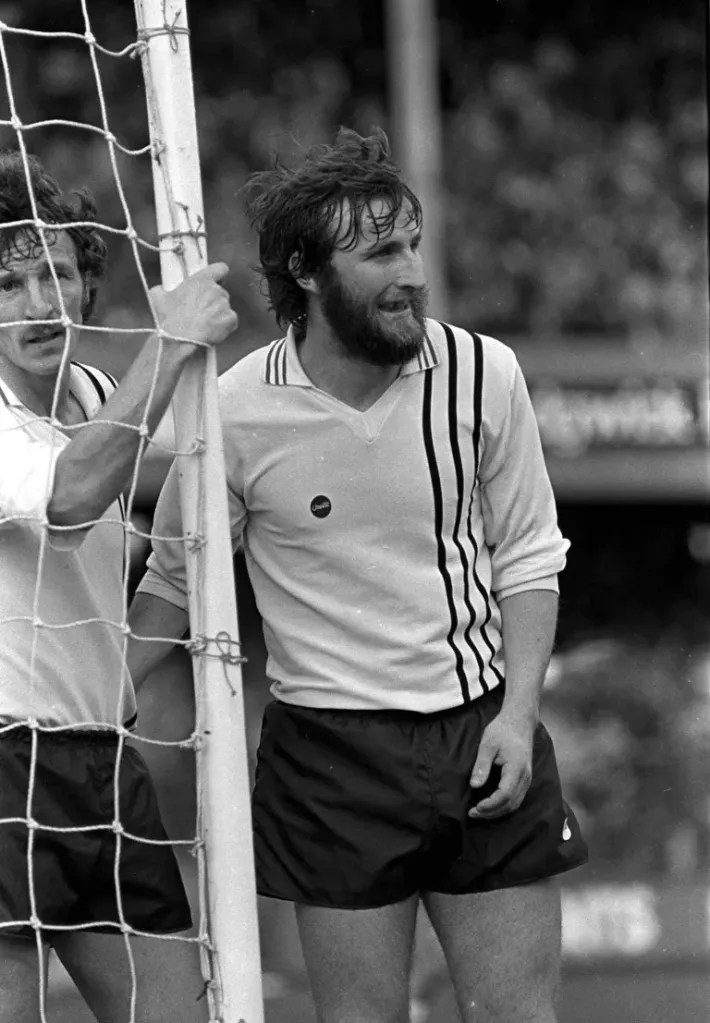


A clean-shaven Dermot in the St Pats colours in 1975-76; in his fearsome bearded prime, as captured by Sportsfile’s Ray McManus; captaining Dundalk against Celtic (skippered by Danny McGrain) and FC Porto in the European Cup in 1979; swapping pennants with Phil Thompson at a friendly against English League champions Liverpool at Lansdowne Road in 1980; lining up before the FAI Cup Final victory over Sligo Rovers in 1981; heading home and “man marking” for Glentoran in the Irish League the following year.
When the proposed Adelaide move went by the wayside, Dundalk manager Jim McLaughlin swooped in to bring him to Dundalk. It proved yet another masterstroke by a man Keely would come to call his “footballing father”. Making his debut against Rovers that September and partnering fellow ‘Hall of Famer’ Paddy Dunning in the heart of a heavenly back four — also comprising McConville and Lawlor — they formed a defensive shield that achieved cult hero status among the ‘D Shed’ faithful.
Uncompromising, fearless, and equipped with a razor-sharp footballing brain, Dermot’s steel underpinned a side that swept all before them in the 1978–79 season, capturing a famous domestic League and FAI Cup double. The supporters selected him as their player of the year and half-a-dozen Inter-League caps followed, encompassing a Far East tour to Malaysia and Singapore, and a memorable trip to Argentina.
Dermot wasn’t just a physical presence; his quality and leadership caught the eye across the Irish Sea. After the teams met in the European Cup — an adventure lasting six ties that saw Dundalk only concede once in three home games — Celtic came calling, eager to bring the combative Dubliner to Glasgow given his defiant displays in the underdogs’ 3-2 aggregate defeat.
“That night in Parkhead against Celtic was the standout moment – a night when 50,000 people stayed behind after the game to applaud us after Celtic had gone off the pitch,” Dermot remembers. But there were a few reasons that would-be dream deal fell through.
It’s said that Bhoys boss Billy McNeill insisted that Dermot lose his signature beard (strange given his own skipper Danny McGrain was scarcely clean shaven). More pertinently perhaps, while the clubs agreed a fee, the basic wage on offer was well below what Dermot was earning as a teacher and part-time player, and so he decided to stay put and keep his house. Though he later admitted an element of self-doubt had kicked in.
Continuing to forge a burgeoning legacy on home soil, as captain he led the Lilywhites to another FAI Cup and League Cup triumph in 1981. He thrived on pressure. “That’s what makes you play… expectation! When you are expected to win, lovely… bring it on! Let’s win it again, because when you win here, boy… it’s great!”
Next, at the atrocious height, or low, of the Troubles, he headed north of the border for a trophy-laden interlude with Glentoran, winning the Irish Cup in 1983.
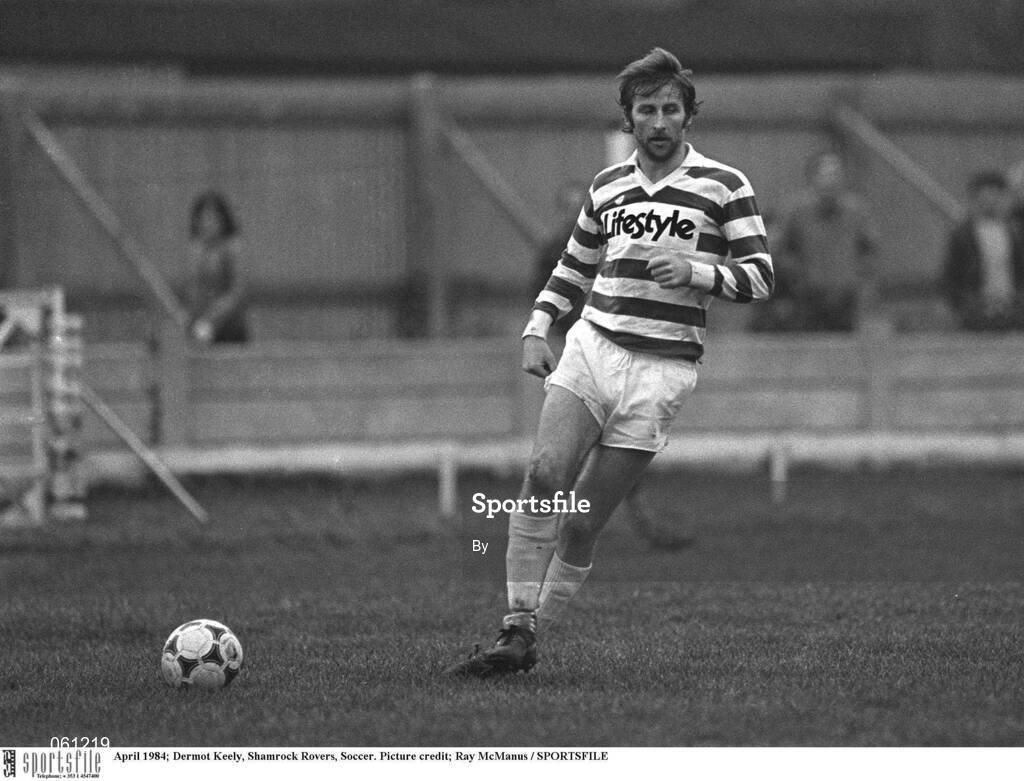
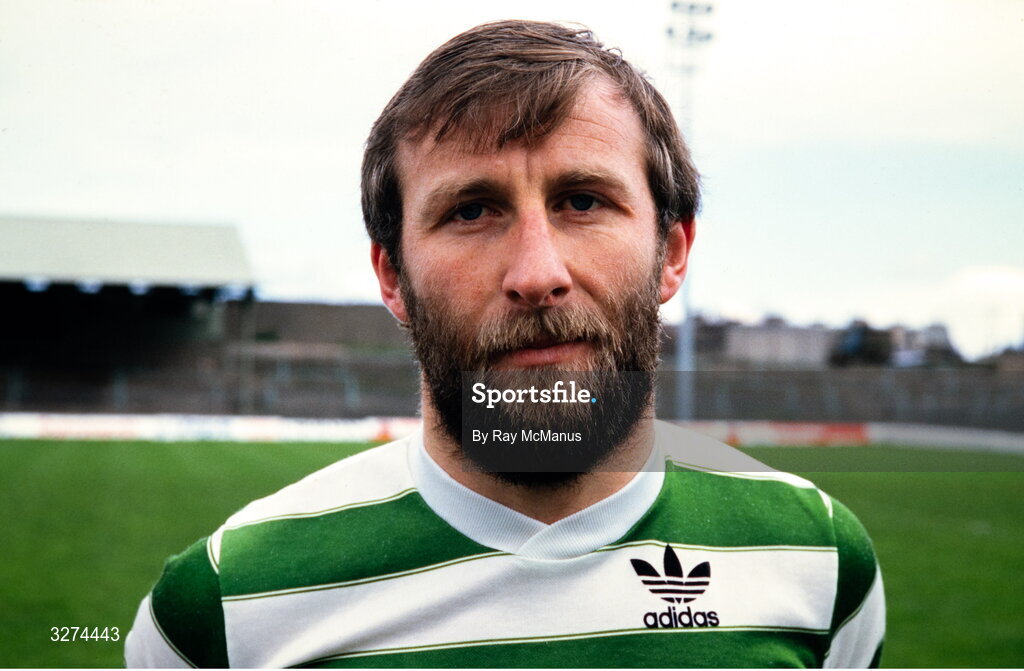


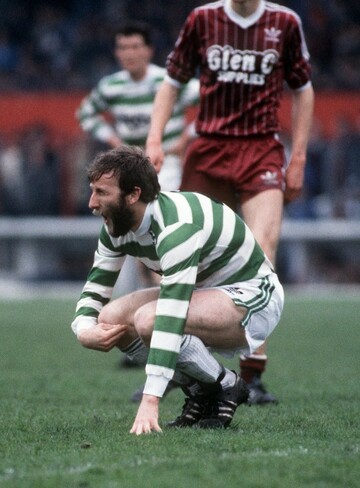
Glory days with Shamrock Rovers in the mid-eighties: on the ball in 1984; media event at Milltown the following year (Ray McManus/Sportsfile); 1986 European action against Celtic’s Frank McGarvey; feeling the pain in the 1985 FAI Cup Final against Galway (Billy Stickland/Inpho)
Dermot’s next move was back to his native capital as player-manager of pro wannabes UCD in 1983-84, playing against Everton in the European Cup Winners’ Cup, but he was soon enticed from Bellfield by all-conquering Shamrock Rovers. As a Hoops player and player-manager, he would win multiple league titles, including a four-in-a-row (above), and an FAI Cup. By this stage, over 14 seasons as one of the country’s most formidable stoppers across 300-plus league appearances, Keely, now a household name in Irish sport, had cemented his status as one of domestic football’s ultimate serial winners.
THE MIRACLE OF ’95
“Wearing rose-coloured glasses” and fuelled by “gut feeling”, Dermot returned to Oriel Park as manager in November 1993. By then, Dundalk were in dire financial straits and desperately searching for a spark. What followed in the ’94–95 season — one of the most astonishing, dramatic title races in League of Ireland history — was the stuff of fairytales.
Up against well-resourced, star-studded opposition in Derry City and Shels, Dermot operated on a shoestring budget, moulding a tight-knit, resilient squad with a no-quit mentality. Heading into the final day of the season, Derry City held the upper hand, but Dermot’s side did what they had always done under his tutelage — they dug in.

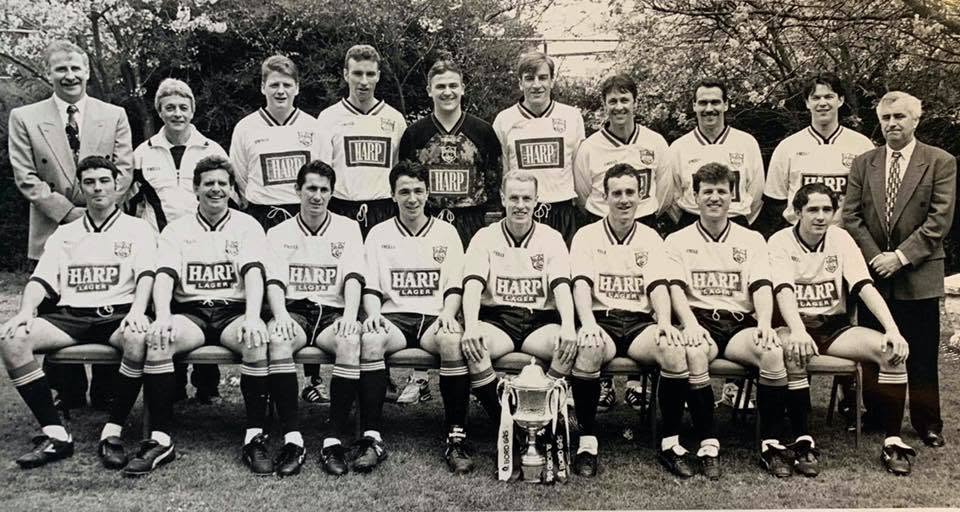


Giving sideline instructions as Dundalk boss; the 1994-95 title-winning side; with the man who brought him to Oriel Park, Jim McLaughlin, and as proud member no. 4 of supporters club The 1903 in 2021.
Dundalk beat Galway United 2–0 at Oriel, while Derry faltered at home against Athlone Town. Against all odds, the league championship trophy was headed back to Louth. “The only time we topped the table was on the last day, the only time it mattered,” Dermot noted.
Fighting fires at every turn, the Keely charisma and know-how combined to achieve a feat that puts him in the rarest of company: a winner of league titles with Dundalk as both player and manager. Speaking warmly of his connection to the club, Dermot, who was quick to get behind supporters club The 1903 when it was established, has never hidden what ‘The Town’ means to him: “I loved Dundalk and the people in it,” he reflected. The feeling is entirely mutual.
KEEPING IT REAL
While Dundalk claimed a special place in his heart, Dermot’s footprint spans almost the entire Irish football map. From those early days with Home Farm to aforementioned player-manager stints at UCD and Rovers, he later led both Sligo Rovers and Finn Harps to promotion and also took charge of Longford Town, Athlone Town, Derry City, Dublin City, and LOI newcomers Kildare County. Dermot was the ultimate soccer troubleshooter, taking the reins at four clubs during 1996 alone.
His finest hour as a manager outside of Dundalk arrived during a successful spell at Shelbourne. His tenure at Tolka was defined as much by his fiery but fond relationship with legendary, larger-than-life Shels chief Ollie Byrne as it was by silverware. In 1999–2000, he led them to a historic League and FAI Cup Double — earning the Soccer Writers Personality of the Year Award — and followed it up with another Premier Division title in 2001–02.



Dermot in manager mode and, bottom right, alongside Jim McLaughlin, Jim Murphy, Des Casey, Liam Tuohy, Tommy Connolly and Turlough O’Connor at the launch of Jim Murphy’s book The History of Dundalk FC – The first 100 years at Dalymount Park in 2003. Photos: Dundalk FC/Sportsfile
For decades off the pitch, while working as a dedicated Maths, English and PE teacher — and mentor — at De La Salle College in Churchtown (where Damien Duff was among his students), Dermot also served as the straight-talking, take-no-prisoners voice of national football via an essential weekly column in the Irish Sun spanning 17 years. He never pulled a punch in print either, frequently calling out the structural neglect of the league by the powers that be.
He shared that candid zeal with another manager-cum-columnist whose unlikely allyship emerged in the most heartbreaking manner in May 2021. That was when Dermot’s son, Alan — a talented and popular League of Ireland player in his own right who had settled back in Dundalk — died suddenly in his sleep from a blood clot in his lungs, aged just 38.
The unspeakable grief visited on the family, including Alan’s partner and their two children, his brother Peter and mum Olive (who sadly passed a few months later) endures to this day.
“It was amazing the number of people who I’d kicked over the years and kicked me who got in touch and wrote or said nice things,” a devastated Dermot said at the time. “But then there were the people who loved Alan just for himself. Anyone who knew him, he affected their lives.”
At the funeral, Pat Dolan — with whom Dermot had many touchline feuds — walked up to pay his respects. “It was only football,” Pat told him gently. “I’m so sorry for your loss.” As Dermot told Garry Doyle of the Irish Mirror: “It genuinely touched me in a way I can’t properly describe. For years we didn’t speak… Yet for Pat to go out of his way to do that, it meant the world…
“That’s why League of Ireland people stick together. We have to. Because we feel no one else will do it for us. And when you are in your hour of need, League of Ireland people will be there for you.”
MONUMENTAL IMPACT
That emotional insight was given around the launch of his fascinating 2024 autobiography, titled, with typical self-deprecation, Better Without The Ball (the jacket featuring McLaughlin’s tongue-in-cheek assessment: “If there was no ball involved, Dermot would have been the best player in the world”). Co-written with Neil O’Riordan and rated by many as the best League of Ireland book ever penned, Keely captured the grit, humour, humility and reality of a career spent, and relished, in the trenches of Irish soccer.


Alongside figures like McLaughlin, Liam Tuohy and Stephen Kenny (for whom he has great respect), Dermot Keely sits securely on the ‘Mount Rushmore’ of League of Ireland legends. Across his 37 years playing and managing, he won nine Premier League titles (five on the field), seven FAI Cups and an Irish Cup as well as multiple individual accolades, including a PFAI Player of the Year Award and SWAI Personality twice.
It’s an incredible haul for a man who, with characteristic understatement, feels “so lucky as someone with limited ability to get what I got.” But everyone else knows how good Dermot was. He ranks Pat Byrne and Tommy McConville as the best he ever played with: “both were unbelievably talented and were far ahead of anyone else.” Of those he faced on the field, Jackie Jameson was “a little genius” he couldn’t get near, while Des Kennedy and Ger Duggan at Limerick and John Minnock of Athlone were also up there.
Even in well-earned retirement — much of it since 2017 spent with Jane under the Lanzarote sun (where he ran his own bar pre-Covid); opting for sunnier climes after “years of playing on boggy pitches and kicking and heading opponents instead of balls” — Dermot’s passion for the game here remains undiminished.

“I don’t need to watch Manchester United,” Dermot told Doyle. “I don’t need Liverpool. I don’t need Real Madrid.
“I love the League. It’s ours… We are part of it. We’re the underdog. People look down on us. But we keep going. It’s just like life. You have your ups and downs, but you keep plugging along.”
Well said, Dermot. And a massive well done on everything you have put into football across Ireland. Good guys do win. And this bona fide legend won the lot.
- Read Dermot’s profile on the Dundalk FC Who’s Who website
Article by Jamie O’Keeffe
Leave a Reply