
Great Scot Tom joins Dundalk legends club

Tom McNulty’s recognition as a Dundalk FC Centenary Legend and the newest Dundalk FC & IPFBA Hall of Fame inductee at Oriel Park on Friday, July 17th reflects the popular Scotsman’s remarkable impact across his 15-year League of Ireland career.
Born in 1962, Tom grew up in Hamilton and played schoolboy football alongside the likes of future Celtic stars Paul and Willie McStay, and the competitive edge of that grounding shaped his standards and trademark steel, allied to no little speed and skill.
He played a lot of underage football in Glasgow’s nearby Govan district, “a really rough area where you had to look after yourself or be walked all over,” recalled Tom, who is widely regarded as one of the toughest players to ever do battle in the domestic game.

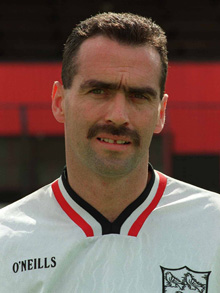

After a spell with Partick Thistle’s youth setup, his family moved to Dundalk, and Tom quickly found his feet locally with Park Rangers, Greenfield United, and then Bank Rovers, where he operated in attack. His dynamic performances and eye for goal, inspiring an epic FAI Cup run only halted by Waterford in round six, brought him to the attention of Tommy Connolly, the first of seven Dundalk managers Tom would play under.
He joined The Town ahead of the 1984–85 season and soon settled. His debut came in a League Cup tie against St Patrick’s Athletic, where he set up the opening goal. Not long after, he scored his first goal for Dundalk against Cork City and was christened “The Flying Scotsman” by the press. By the end of that first season, he had barely missed a match and picked up a Supporters Club Player of the Month award.

Tom became a fixture in Dundalk’s midfield. Anchoring things in front of the backline, “Scottie” wasn’t a showman but had a happy habit of showing up in the opposition box at pivotal moments. However, after three seasons at Dundalk, Tom moved to First Division Finn Harps (missing out on a double), but his return in 1989 under the canny Turlough O’Connor would coincide with career-defining success.
Over the next eleven seasons, Tom took his competitive appearances for the Lilywhites to 476 and scored 46 goals, including an unforgettable winner against Cork at a packed Turners Cross on the final day of the 1990-91 season to swing the title Dundalk’s way.
Looking back at that triumph years later, Tom, who scored 10 times from midfield during the campaign, said modestly: “Our team that season was just exceptional – Alan O’Neill kept 23 clean sheets, Peter Hanrahan’s (20) goals, Terry Eviston (10) – it was so easy to play with those lads and I didn’t feel under any pressure whatsoever.”
A terrible Cup final experience against Rovers in 1987 (0-3) had made him resolve never to repeat that feeling. After that, “When the big games came along, I always seemed to do really well in them.” It was no accident. As Dundalk defender James Coll put it, “Whenever we got to a big match situation, you just knew that Tom McNulty would have a chance.”
In 1995, he came up with the vital goals against Galway United to deny hot favourites Derry City the championship, and famously scored again in the closing‑day decider against the Candystripes to shade the league in front of a packed Oriel Park after one of the most dramatic title run-ins ever. Dermot Keely described Tom as “just sensational” during that period.
Fearless on the field, the Mighty Mac covered ground, won tackles, pressed, and kept the engine room ticking over. Given his physical, no-nonsense style, Tom was often referred to as an enforcer. But he also brought calmness on the ball and an understated passing range that enabled Dundalk to quickly shift from the defence to attack.
Because he didn’t drift in and out of games, Tom was also the kind of player managers could trust and could build a team around. He set the tone: rock solid, taking no prisoners, and decisive when the pressure peaked. And there was always that goal threat he carried.
1991: ‘MIGHTY MAC HITS GLORY GOAL’

By the time he finished, aged 38, at the end of the 1999–2000 season, Tom, with his warrior spirit, combative cult-hero style and matchwinning consistency, had firmly established himself as a legend not alone in Co. Louth but within the LOI as a whole.
Along with those league titles in 1991 and ’95, he remains among a small group of players to have played more than 400 games for Dundalk. His recognition by the club and the IPFBA simply underlines the undeniable influence he had over a decade and a half in which Tom led by example and rose to the occasion time and again.
- See Tom’s profile on the Dundalk FC Who’s Who website
Article by Jamie O’Keeffe