
Dundalk dynamo Paddy takes deserving place in ‘Town’ Hall of Fame

When Dundalk FC and the Irish Professional Footballers Association welcomed Paddy Turner into the Hall of Fame at Oriel Park on Friday, July 10th, it recognised a player whose intelligence, craft and consistency helped shape a very special era in the life of the proud Louth club.
Born in Galtymore Road, Rialto, Dublin in 1939, Paddy’s dad died when he was very young and his mother and step-father raised him well. His football journey began with St Finbarr’s, Shelbourne’s nursery club. Even as a teenager he stood out — quick‑thinking, technically sharp, and already comfortable in senior company.
An apprentice electrician, he broke through at Shamrock Rovers (much to Shels’ chagrin) in 1957 at just 18 years of age, playing on the right wing in a star‑laden side. Paddy sampled European football early against Nice and finished the season as Rovers’ second‑top scorer with nine goals, winning a League of Ireland medal in 1958-59.
A season at Shelbourne followed, before a bold move to Scotland with Morton, where he scored 22 goals in 47 appearances. Paddy’s form earned him a transfer to Celtic in May 1963 (Bhoys chairman Bob Kelly was looking for the next Charlie Tully) and, just two weeks later, his first of two Republic of Ireland caps — a 1–0 win over Scotland at Dalymount Park.

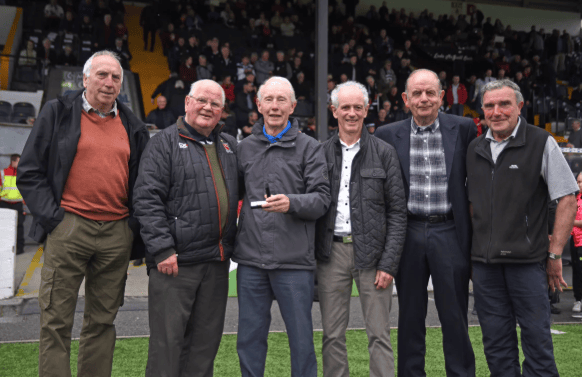

Pictures of Paddy Turner in his prime and (centre) receiving a replica of his misplaced 1966-67 League of Ireland winner’s medal from Dundalk title-winning team mates (Patsy McKeown, John Murphy, Jim
Burke, Francie Callan and Patsy Cole) on his 80th birthday in April 2019.
HOME DEBUT HAT-TRICK
The emergence of the brilliant Bobby Murdoch at Parkhead limited Paddy’s opportunities under Jimmy McGrory. And so, with his wife and family also failing to settle, after a year, having just played against Spain in the World Cup qualifiers, Celtic agreed to transfer him to Glentoran in Belfast for a nominal fee, with add-ons attached to future transfers.
While at The Oval, Paddy scored in both legs of a European Cup tie against Panathinaikos (losing 4-5 on aggregate) — a rare achievement for an Irish League player in those days.
However, the constant travel from Dublin began to take its toll. Dundalk sensed an opportunity and in January 1966, secretary Paddy McCourt moved quickly, securing Paddy for £500 — a fee he repaid almost instantly, scoring on in his debut against Shels and netting a hat-trick on his first Oriel Park appearance against Drogheda.
With Oriel Park revamped and reopened that summer, The Town turnstiles were doing brisk business thanks to exciting new signings like Paddy. With his pace, guile, precise distribution and eye for goal, he became a key member of a Lilywhites side on the cusp of success.


Left: Paddy Turner (Dundalk), right, tests out an injury with some sprinting at League of Ireland squad training at Tolka Park in September 1970. He was forced to withdraw from the game against their Scottish counterparts at Parkhead. Also included are, from left: Al Finucane (Limerick), Jimmy McGeough (Waterford) and Mick Smyth (Shamrock Rovers).
Indeed, the historic 1966–67 season under player-manager Alan Fox saw Dundalk deliver a record haul: League champions, Shield winners, Top Four winners, and Runners‑up in the City Cup and Leinster Cup.
Working and training in Dublin and travelling by rail to Dundalk at the weekends, Paddy was practically an ever‑present. Linking midfield and attack with intelligence and timing, he formed lethal partnerships with Danny Hale, Derek Stokes, Ben Hannigan, and Turlough O’Connor.

MULTIPLE HONOURS
Across seven hugely enjoyable seasons at Oriel Park, Paddy racked up 244 appearances and 104 goals, making him one of only five players to score more than a century for Dundalk.
He won seven major trophies and was leading scorer (with 21) and Supporters’ Player of the Year in 1969–70. His form earned a League of Ireland representative cap to go with his earlier Irish League one, scoring in a 3–1 win at Windsor Park.
Paddy’s final Dundalk appearance came in the 1972 FAI Cup semi‑final, where he scored two brilliant goals to give Dundalk a 2–0 half‑time lead. But a broken leg (with which he somehow played on for 20 minutes) and a Waterford comeback denied him the one medal he never won.
He played one fifteenth and final season with Bohemians, scoring in the 1973 Leinster Senior Cup final, before retiring after nearly 500 appearances and close to 200 goals across Ireland and Scotland.
With his dynamism and work ethic, Paddy Turner was a scorer, creator and elevator of those around him. Off the pitch, having become a telephone engineer (and a 7-handicapper at Greystones Golf Club) Paddy’s warm personality and generosity made him many friends to go with the admirers he won on it.
His deserving induction into the Dundalk Hall of Fame underlines the fond place in the club’s history of an attacking maestro who scored goals for fun.
See Paddy’s Dundalk FC Who’s Who profile
Article by Jamie O’Keeffe
