
League of Ireland titan McConville is fondly remembered at Oriel Park
Members of the late, great Tom McConville’s family were present in Oriel Park on Friday (June 26) to proudly receive a posthumous Hall of Fame Award jointly presented by Dundalk FC and the Irish Professional Footballers Benevolent Association.


Hall of Fame Honour for Tommy McConville at Oriel Park: Included (left) are Tom McConville Jnr, Paula McArdle, Don McArdle and Ava Connolly, plus (right) Carol McConville and Kristina Murtagh with Martin Lawlor, Secretary of the Irish Professional Footballers Association, which co-sponsored the posthumous award.
Universally regarded as a gem of a person, Tommy sadly died in October 2013, aged 67, having attained a stature that places him among the best players to ever grace the League of Ireland.
Fondly known to fans as Tommy Mac, he was synonymous with his native Dundalk, starring for The Town over an unsurpassed 21-year period, making a record 580 appearances spanning two spells between the mid-sixties and 1986.
He won four league titles and three FAI Cups, not to mention six senior Ireland caps between 1971 and 1973 and many more Republic/representative squad selections. Yes, Tommy McConville was that good — genuine international class.
BECKENBAUER COMPARISON
Indeed, the mere mention of his name echoes a golden standard of ball-playing defending. Described by famed journalist Con Houlihan as “the Charlie Hurley of the League of Ireland” and by the Oriel faithful as their own “Franz Beckenbauer,” Tommy combined elegance with exquisite reading of the game. He was a thinking man’s footballer as well as a dedicated, gifted athlete.
He was described by Con Houlihan as ‘the Charlie Hurley of the League of Ireland’ and likened to ‘der Kaiser’ by fans.
Born in Dundalk in 1946, young Tom was a natural sportsman who balanced Gaelic football with De La Salle and Clan na Gael alongside schoolboy soccer. The GAA’s ban on foreign games forced a choice and he opted for the latter. Guided by underage coach Colm Bellew, as an 18-year-old he walked directly into the Dundalk ‘B’ team under the legendary (suit-and-trilby-wearing) Gerry Doyle.


Tommy in his Lilywhites prime and in later years watching The Town. Right: in the Oriel dressing-room with boss Jim McLaughlin and Dundalk team-mates (and fellow Hall of Famers) Richie Blackmore and Martin Lawlor before playing Spurs in the European Cup Winners’ Cup in 1981.
Click button for Dundalk Democrat Q&A the year before he passed
With his first-team appearances initally confined to friendlies, Tommy and his older brother Brian had a brief spell in the Irish League with Bangor during World Cup year (Charlie Tully, the famous Celtic centre-forward, was manager with Ted Harte, ex-Dundalk, his assistant). Indeed, three of the McConville clan — younger sibling Wally completing the hat-trick — all donned the Dundalk colours during that era.
Tom returned home to capture his first senior medal in the 1967–68 Dublin City Cup and made his League debut against Cork Celtic at Turner’s Cross. It was under Liam Tuohy’s guidance that he transitioned permanently into the central defensive number five jersey.


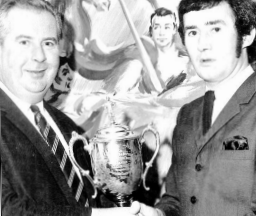
Clockwise from top left: in action against Finn Harps’ Brendan Bradley in 1983-84; Tommy displaying the jersey Pele given to him while they were New York derby rivals in the NASL; receiving the Supporters Player of the Season award from Paddy McCourt, director, in 1971-72.
However, Dundalk’s perilous financial difficulties in 1972 forced a sell-off of several star assets. Tommy was among those transferred, moving to Waterford (as did Brian) where ex-Manchester United defender and European Cup winner Shay Brennan was player-manager.
Training at Oriel during the week, he helped the Blues (“a terrific team”) to what is their last league title in 1973, but his time at Kilcohan Park would end in rancor. Following a magnificent performance for Ireland in the World Cup qualifiers at Lansdowne Road, Frank O’Farrell shook hands with Shay on a £30,000 deal to bring the to 26-year-old to Old Trafford — “a dream come true” for the lifelong Red Devils supporter.
The move to Manchester United collapsed and Tom refused to ever wear the Waterford jersey again.
But the move collapsed when the Waterford board reputedly demanded double the fee, causing United to swiftly pull the plug. Understandably devastated, Tommy, dubbed The Prince on Suirside, furiously vowed never to wear the Waterford shirt again.
True to his word, when the team bus to Ballybofey pulled up outside his house the following Sunday, he refused to board and negotiated a free transfer to Tuohy’s Shamrock Rovers on the condition that Waterford wouldn’t receive a penny.
McLAUGHLIN ERA
Winning the League Cup in his one season at Milltown, Tommy’s fortunes dovetailed with Jim McLaughlin’ took the reins’s arrival at Dundalk in 1975. “A very shrewd man,” he desperately wanted him to sign and board members personally pooled funds to pay the instalments required to bring McConville back to Louth.
Money was never as well spent. Over the next seven seasons, Tommy was a vital cog in the most dominant side in LOI history. When McLaughlin paired Paddy Dunning and Dermot Keely in central defence, Tommy was repositioned to wing-back opposite Martin Lawlor. This backline became known as the “Mean Machine,” the most dominant defensive force in the country.
McConville also played in 19 European ties for Dundalk, lining out against Liverpool, PSV Eindhoven, and Tottenham Hotspur. Then there was the 1979 European Cup tie against Glasgow Celtic when he almost achieved immortality. After a heroic 3–2 defeat in Glasgow, 20,000 packed into Oriel to witness a historic rearguard action by the home side.
The faintest of touches from a team-mate prevented Tom from getting a memorable winner against Glasgow Celtic.
Late in the match, deadlocked at 0–0, a cross from the left found McConville waiting at the far post. Just as he prepared to volley Dundalk into the next round, teammate Cathal Muckian got the faintest of touches, enough to ruin his colleague’s connection. With customary good humour, Tommy later joked that if he’d scored, “They’d have replaced the Maid of Erin with a statue of me!”

Tommy’s longevity was unprecedented, spanning 21 years and 6 months between his first and last appearances for his hometown club. And his footballing travels took him all over the world, representing the League of Ireland 34 times in places like Chile, New Zealand, and Argentina — where he even shared the pitch with a young Diego Maradona, who scored the lone goal in a tight 1–0 defeat.
He also spent five enjoyable summers in the seventies in the North American Soccer League with Washington Diplomats and New York Appollo, a 77-game adventure where he rubbed shoulders with icons like Pelé (who regarded him very highly), Beckenbauer, and George Best.
Across his entire journey, Tommy compiled an astonishing 819 first-class appearances, ending with stints as player-manager of Finn Harps and Newry Town. Having rekindled his love of GAA by playing his part in a senior championship success for CNG in the mid-eighties, he togged out for Bank Rovers in an FAI Cup match against Tramore Athletic in 1993, aged 47.

He was a keen supporter of charitable causes, regularly playing in fundraisers as far afield as Waterford, a place he always retained a soft spot for despite that sorry what might have been transfer episode.
After finally succumbing to cancer following a long and brave battle 13 years ago, Tommy’s funeral was a testament to the popularity and legacy of a special player and personality who epitomised the beautiful game.
With 17 major honours at Dundalk, as well as the 1982 Soccer Writers Personality of the Year Award, and three Club Player of the Year accolades, his posthumous induction into the Hall of Fame further underlines the unforgettable legacy of Tommy McConville; a player who was class personified on and off the field.
View Tommy’s career biography and lots more photos on the Dundalk FC Who’s Who page
Read Dundalk FC historian Jim Murphy’s tribute to ‘the greatest ever’
Article by Jamie O’Keeffe